What is recombination?
Recombination is an evolutionary mechanism where two distinct organisms exchange genetic code to produce a chimeric genome (VanInsberghe et al. 2021). This manifests as a novel combination of alleles into blocks or “chunks” across the genome (Figure 1).
Recombination is of particular concern for genomic surveillance, because it can lead to substantial genetic change over a short period of time. Public health programs take into account this rate of genetic change to inform policy recommendations, such as vaccine effectiveness and booster frequency (Malik et al. 2022).
SARS-CoV-2 has an estimated substitution rate of 2 substitutions/month or 24 substitutions/year (Tay et al. 2022). However, the recombination event that led to the Delta-Omicron recombinant XD produced a chimeric Delta genome with 25 new substitutions originating from Omicron (Figure 1). This single event produced the same amount of mutations as would have been expected over the course of a year. While more mutations are not necessarily beneficial to the organism, there remains the concerning possibility that recombination can rapidly increase the infectivity and severity of a pathogen.
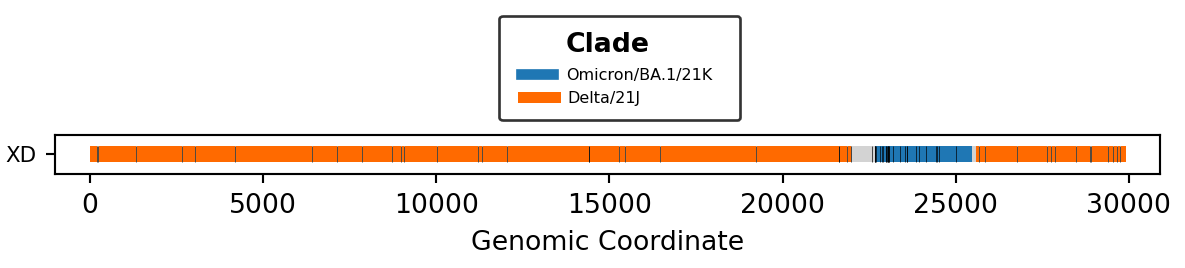
Figure 1. Genomic composition of the Delta-Omicron recombinant XD.
Pipeline Definition
A recombinant SARS-CoV-2 lineage is defined as sequences with unique combinations of:
Lineage assignment (ex.
XD)Parental clades (ex.
Delta/Omicron/Delta)Parental lineages (ex.
AY.4/BA.1/AY.4)Breakpoint intervals (ex. Breakpoint 1:
21988-22672, Breakpoint 2:25470-25583)
If two sequences share the same lineage assignment (XD) and parental clades (ex. Delta/Omicron) but differ in their parental lineages (AY.4/BA.1/AY.4 vs. AY.44/BA.1/AY.44), they will be classified as distinct recombinant lineages. The sequence with parental lineages AY.44/BA.1/AY.444 will be renamed XD-like. This indicates that its closest known lineage is XD but that it differs from the expected genomic composition of true XD.
Designated Recombinants
Designated recombinants from pango-designation can be identified in the “positives” pipeline output by a lineage assignment that starts with X (ex. XD, XBB).
Novel Recombinants
Novel recombinants (i.e. undesignated) can be identified in the “positives” pipeline output by a lineage assignment that does not start with X* (ex. BA.1.1) or with a lineage assignment that contains -like (ex. XM-like).